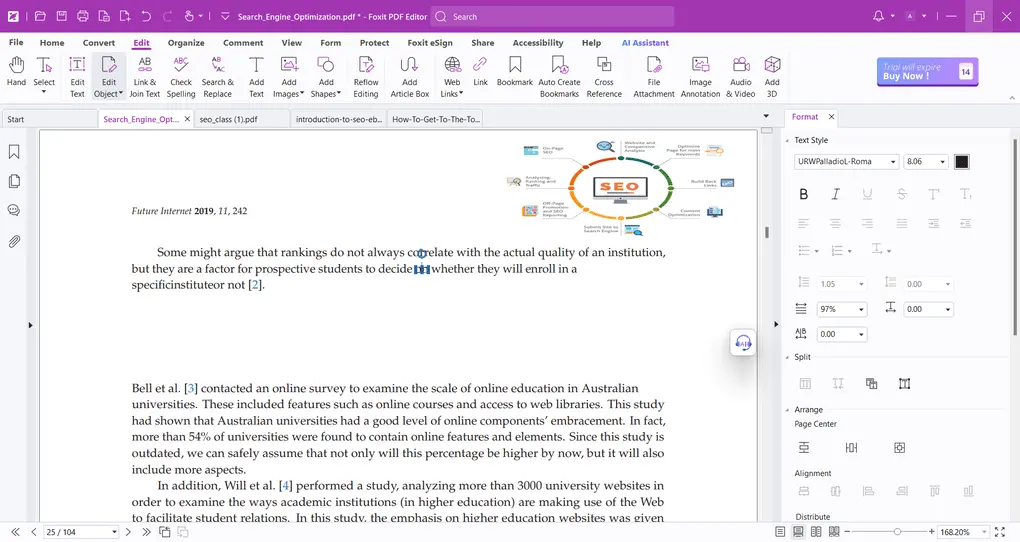
Foxit PDF Editor is a desktop application designed for professionals who need to create, edit, convert, and manage digital documents. Instead of treating PDFs as static pages, the software turns them into interactive elements connected directly to business systems. Users can extract text, generate forms, redact sensitive information, and apply legally binding signatures without switching between multiple browser tabs. The local installation ensures that massive file handling, heavy optical character recognition (OCR) tasks, and batch processing rely on local Windows system hardware rather than internet bandwidth. This prevents bottlenecks when working with graphic-heavy manuals, scanned architectural blueprints, or multi-page legal contracts.
A major reason businesses deploy the desktop application rather than relying entirely on lighter, browser-only PDF tools is the direct connection to enterprise environments. The software acts as a Model Context Protocol (MCP) Host, allowing the interface to communicate directly with platforms such as Salesforce, Jira, and Gmail. Workers can create a Jira ticket based on a project brief or update a Salesforce customer record directly from the PDF viewer. This reduces the friction of manual data entry and copying text across different windows during daily administrative tasks, keeping the focus entirely on the document being reviewed.
Furthermore, managing the software locally allows IT departments to enforce strict corporate security policies and control the flow of information. Administrators can manage updates through a central console and restrict sensitive data from passing through unauthorized third-party servers. By relying on Double Key Encryption and built-in redaction tools, organizations ensure that confidential legal documents, financial reports, and employee records remain protected both in transit and at rest.
Key Features
- Model Context Protocol (MCP) Host: The software connects directly to external services such as Jira, Salesforce, and Gmail. Users can highlight text within a PDF and generate support tickets or update customer records directly from the application interface, preventing constant window switching.
- Optical Character Recognition (OCR): The application scans images and flattened documents to convert them into searchable and editable text. Users can select the exact language of the document, process hundreds of pages in bulk, and correct any misidentified characters before exporting the final file.
- Smart Redaction: Instead of manually drawing black boxes over sensitive data, users can set parameters for the built-in AI to scan for social security numbers, credit card details, or specific names. The software then permanently removes this text from the underlying file code, preventing anyone from copying the hidden data.
- Document Merging and Splitting: Users can combine multiple file types, including Word documents, Excel spreadsheets, and JPEG images, into a single PDF binder. The thumbnail pane allows dragging and dropping individual pages to reorder them, or selecting specific page ranges to extract into separate, smaller files.
- Interactive Form Creation: The interface includes design tools for adding text fields, checkboxes, radio buttons, and digital signature blocks. Authors can define field properties, set required data formats, customize the tab order for keyboard navigation, and export the collected form data directly to a spreadsheet.
- Double Key Encryption (DKE): For strict compliance requirements, the software integrates with Microsoft Purview to protect sensitive files. This ensures that unauthorized users cannot read the document contents even if they intercept the file outside the corporate network, requiring proper authentication to unlock the data.
- AI Assistant and Smart Commands: The built-in AI tool analyzes document text to generate summaries, translate paragraphs, or rewrite sections for clarity. Users can execute tasks by typing plain text commands, instructing the editor to highlight specific phrases or format headers without manually clicking through menus.
How to Install Foxit PDF Editor on Windows
- Navigate to the official vendor website and download the Windows installer package, selecting either the MSI or EXE format depending on your deployment needs.
- Double-click the downloaded executable file to launch the main setup wizard and load the initial installation modules.
- Review and accept the End User License Agreement to proceed with the setup.
- Click "Advanced Setting" if you need to change the default installation directory, select a specific display language, or turn off usage data collection; otherwise, click "Quick Install" to use the default paths.
- Wait for the setup to copy the application files to your local drive, register the necessary system components, and create desktop shortcuts.
- Click the "Start Now" button on the final screen to close the installer and launch the application for the first time.
- Log in with your Foxit account or corporate single sign-on (SSO) credentials to verify your subscription status and unlock the editing tools.
Foxit PDF Editor Free vs. Paid
Foxit PDF Editor operates strictly as commercial software, requiring a paid license after a 14-day free trial. The vendor does not offer a permanent free tier for its advanced editing features. Users who only need to view documents, fill out basic forms, or apply standard ink signatures can download the separate Foxit PDF Reader, which is available at no cost. However, attempting to modify text, extract pages, or run OCR in the free Reader will trigger a prompt to upgrade.
For users needing the full editing toolkit, pricing is divided into two primary subscription tiers. The standard Editor tier, typically priced around $110 to $130 per year, provides local text modification, OCR capabilities, PDF creation from Microsoft Office files, and basic cloud storage. The higher Editor+ tier costs approximately $14 to $15 per month or $130 to $160 annually. This expanded tier adds Foxit eSign with a yearly allowance of legally binding envelopes, AI-driven Smart Redact tools, larger cloud storage limits, and advanced document tracking.
The built-in AI Assistant features run on a monthly credit system rather than being entirely unlimited. Subscribers receive a baseline of 20 free credits per month to translate text or generate summaries, with options to purchase up to 2000 credits for heavier workloads. While the vendor occasionally offers lifetime perpetual licenses for offline desktop use, those one-time purchases exclude ongoing access to cloud features, eSign capabilities, and future AI updates. Organizations must evaluate whether they want a static local application or a constantly updating cloud-connected tool.
Foxit PDF Editor vs. Adobe Acrobat Pro vs. Nitro Pro
Adobe Acrobat Pro is the established standard for document management, offering deep integration with Adobe Creative Cloud and extensive pre-press printing controls. Users who handle complex color profiles, high-end commercial printing, or advanced accessibility tagging for screen readers often rely on Acrobat. However, it requires a high monthly subscription cost and uses significant system resources, making it heavy for older computers. It also strictly enforces a recurring subscription model, offering very few options for perpetual licensing.
Nitro Pro focuses on volume licensing and straightforward text editing, presenting a user interface highly styled after Microsoft Office. It handles basic merging, signing, and conversion tasks very well and often costs less than Adobe. It appeals heavily to medium-sized businesses looking for a direct replacement for standard office document workflows, though its advanced automated redaction and AI capabilities are not as deep as those found in competing tools. It is an excellent choice for users who simply want to modify text and convert Word documents without a steep learning curve.
Foxit PDF Editor sits between the two as a highly optimized, fast-loading alternative that includes unique external application connections. Users should choose Foxit when they want to edit text efficiently and connect their documents directly to enterprise systems like Salesforce or Jira via the MCP Host. It handles large files faster than Adobe Acrobat Pro on standard Windows machines, while offering more advanced AI redaction and OCR controls than Nitro Pro. It is the better fit for organizations that want intelligent document workflows and cross-application actions without paying the premium price of Adobe.
Common Issues and Fixes
- Program crashes or freezes when saving large documents. This often happens because the software attempts to automatically optimize massive files in the background, consuming all available system memory. To fix this, open the Preferences menu and disable the "Optimize PDF automatically when saving" setting, or use the Repair option in the Windows Apps & Features menu to fix corrupted installation files.
- Printed documents look different from the screen display. Color profiles and missing system fonts cause layout shifts and shading changes during physical printing. Ensure that you select the option to embed fonts when saving the document, or choose the "Print as Image" setting in the print dialog box to force the printer to replicate the exact pixels shown on screen.
- Program fails to launch or freezes on the startup screen. Conflicting background processes, outdated drivers, or corrupted configuration files can block the application from loading its main interface. Try right-clicking the desktop shortcut and selecting "Run as administrator," or temporarily disable third-party antivirus software to rule out overzealous security blocks.
- Application prompts for activation every time it opens. This occurs when the software cannot write the login token to the local Windows registry due to permission restrictions. Fix this by launching the application as an administrator before entering your single sign-on credentials, ensuring the system saves the login state permanently.
- Text appears as unrecognizable symbols after OCR scanning. Poor quality source images or incorrect language settings cause the optical character recognition engine to guess the wrong letters. To resolve this, rescan the physical document at a minimum of 300 DPI, and ensure the correct primary language is selected in the OCR settings before running the text recognition process.
Version 14.0.1.33197 — September 2025
Added:
- PDF Binders (Pro): Compile and organize multiple documents into a single file with auto-generated TOC.
- MCP Host: Native support for Model Context Protocol to trigger actions in Jira, Salesforce, and Gmail directly from the PDF.
- AI Smart Podcast: Convert document content into a two-person audio conversation for easier consumption.
- Tickmarks: Quickly add symbol, number, or letter stamps to documents for review and markup.
Improved:
- Sensitivity Labels: Enhanced protection with User Defined Permissions (UDP) for Microsoft Azure Information Protection.
- Stability: Optimized performance for large file handling and complex editing operations.
Fixed:
- Resolved specific security vulnerabilities to enhance document safety.
- Fixed various stability issues reported in the previous v14.0 release.
Security:
- Addressed critical security patches in the v14.0.1 maintenance update.