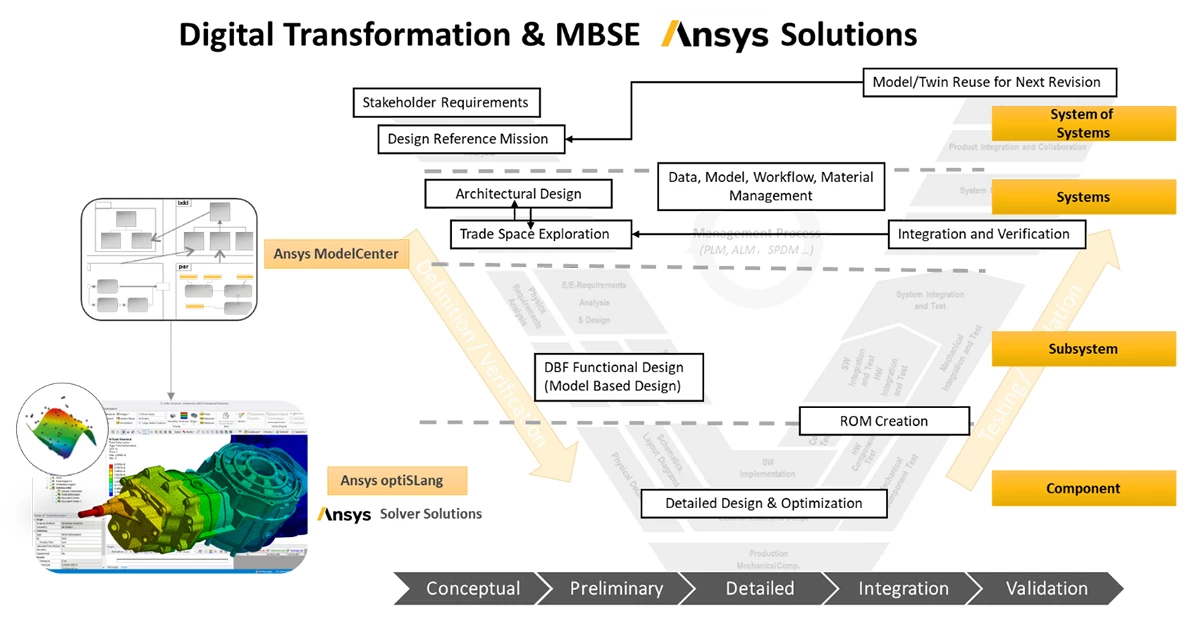
ANSYS optiSLang operates as a specialized process integration and design optimization environment tailored for computer-aided engineering professionals. Instead of manually adjusting individual variables within finite element analysis or computational fluid dynamics models to observe the physical results, engineers rely on this software to orchestrate hundreds of simulation runs entirely automatically. The application serves as a central command hub for multi-disciplinary engineering tasks, linking structural, thermal, and electromagnetic solvers into a unified, repeatable pipeline. By mapping out specific input parameters against required output goals, the application shifts the engineering workload away from repetitive manual file adjustments and toward high-level analytical decision-making. Teams dealing with complex parametric models—where slight variations in material properties, component dimensions, or environmental conditions drastically alter the final product performance—use this tool to navigate massive numerical design spaces efficiently.
A practical workflow often involves taking a base parametric model of an industrial component, such as an electric motor or a turbine blade, and mapping out dozens of geometric variables like slot width, rotor magnetic bridge thickness, or blade pitch angle. Rather than running exhaustive simulations on every single possible combination, the software performs a targeted sensitivity analysis to determine which variables actually influence the final performance metrics. By statistically filtering out the irrelevant parameters, the software significantly reduces the overall computational load. This allows engineering teams to focus their finite element solvers on the most critical inputs, saving hundreds of hours of cluster compute time. The application handles the heavy lifting of extracting output parameters from one solver and feeding them directly as input parameters into the next, managing the entire toolchain without requiring engineers to manually copy and paste text files or spreadsheet data between different physics engines.
While remote computation clusters and high-performance servers handle the raw numerical solving, utilizing the localized desktop application remains critical for workflow construction. The local graphical interface provides direct, visual node-based connections to local installations of modeling software, fluid dynamics engines, and third-party mathematical tools. Building an intricate multi-physics pipeline requires navigating local file paths, configuring interactive Python scripts, and validating component wrappers before dispatching a large parameter sweep. The desktop client securely coordinates the transfer of simulation data to remote execution nodes while maintaining a responsive local schematic builder, avoiding the interface latency that often plagues browser-only pipeline editors during complex workflow creation. This architecture keeps the design logic secure on the local machine while delegating the processor-heavy task of evaluating thousands of design points to external hardware.
Key Features
- Feature Name: Sensitivity Analysis and Metamodeling. The software automatically evaluates thousands of generated design points to construct a Metamodel of Optimal Prognosis. This mathematical representation identifies and isolates the parameters that actually drive product performance, reducing the number of heavy three-dimensional simulations required to understand the design space.
- Feature Name: Multi-Disciplinary Process Integration. Users connect different solver nodes on a visual canvas, passing data between entirely different physics engines. The application extracts output variables from a fluid dynamics solver and maps them directly as inputs into a structural solver, orchestrating complex toolchains without manual spreadsheet data entry.
- Feature Name: Reliability-Based Design Optimization. Moving beyond the search for a single theoretical peak performance metric, the application tests how manufacturing tolerances and material variations alter the final product. It identifies stable design configurations that remain functional when subjected to real-world inconsistencies, utilizing gradient-based methods or evolutionary algorithms.
- Feature Name: Python Scripting via PyOptiSLang. Advanced operators can bypass the standard graphical interface by interacting directly with the dedicated Python client API. This client-server architecture allows engineers to write scripts that programmatically open projects, evaluate designs on the root project level, and automate post-processing data extraction.
- Feature Name: Third-Party Solver Interfacing. The application natively parses standard text-based input and output files, allowing it to control tools outside the primary vendor ecosystem. Users can wrap custom in-house command-line solvers, legacy Fortran codes, or external mathematical scripts into an automated loop by defining where the software should read and write specific text variables.
- Feature Name: Concurrent Design Point Execution. The tool dispatches multiple parameter variations simultaneously to local processor cores or remote server clusters. Engineers open the node properties and set the component execution mode to parallel, allowing multiple structural or fluid simulations to calculate simultaneously and heavily reducing the total turnaround time of a massive sweep.
How to Install ANSYS optiSLang on Windows
- Download the unified vendor installer package for Windows from the official customer portal, ensuring you have administrator privileges and sufficient local storage space for the simulation suite.
- Extract the downloaded archive into a local directory on your drive and launch the main setup executable file to initialize the installation manager.
- Select the option to install the core products and accept the software licensing agreement presented on the initial screen.
- When prompted to select specific applications, expand the extensions or add-ons tree and check the specific box for this optimization software, alongside any other necessary base solvers you plan to use locally.
- Specify the installation path, which defaults to the primary system drive under the standard Program Files directory, and proceed through the remaining prompts to unpack and copy the executable binaries.
- After the main product installation completes, verify that the required FlexNet license manager is installed on your designated local or network server, as the optimization tool requires active license checkouts to operate.
- Launch the client licensing settings utility, input the correct hostname and Transmission Control Protocol port (usually port 1055 or 1056) of your license server, and save the configuration to establish the connection.
- Open the primary workbench environment and verify that the optimization system nodes now appear in the toolbox on the right-hand side of the interface, confirming they are ready to be dragged onto the project schematic.
ANSYS optiSLang Free vs. Paid
This software operates strictly as a commercial enterprise product, and the vendor does not offer a free version or an open-ended free trial for general commercial use. Access is strictly governed by a centralized license manager, requiring organizations to purchase specific entitlement tiers based on their computational needs and the number of concurrent design variations they intend to run. While academic licenses exist for university research, commercial engineering firms must negotiate contracts directly with the vendor or authorized regional resellers to obtain the necessary security keys.
The standard licensing structure is divided into multiple tiers: Base, Pro, Premium, and Enterprise. The Base tier is often included automatically with specific premium solver licenses, giving users access to fundamental parametric design studies directly inside the standard modeling environment without requiring an additional standalone purchase. Moving to the Pro or Premium tiers unlocks advanced sampling algorithms, complex workflow automation node structures, and the ability to process continuous signals and field quantities rather than just static scalar values.
Higher software tiers explicitly govern multi-threaded parallel processing capabilities. A Premium license typically permits four concurrent parametric design point variations, while an Enterprise license expands this limit to eight concurrent variations. For burst compute scenarios or cloud execution, organizations can also consume elastic units. Under this usage-based pricing model, running optimization workflows consumes a set number of elastic computing units per hour. This allows engineering teams to scale up massive design sweeps on remote hardware clusters without purchasing permanent perpetual licenses for temporary peak workloads.
ANSYS optiSLang vs. Altair HyperStudy vs. Dassault Systèmes Isight
Altair HyperStudy functions as a dedicated design exploration tool that excels within its own specific vendor ecosystem, particularly when paired with meshers and solvers like OptiStruct or Radioss. Engineers choose HyperStudy when their primary simulation workflow already revolves around Altair products, as the direct data integration is highly efficient and requires minimal setup. However, its interface and workflow construction logic can feel less intuitive for operators who rely heavily on outside tools, making it a highly specialized choice dependent on a company's existing enterprise software contracts.
Dassault Systèmes Isight stands as a veteran process integration framework utilized heavily in the aerospace and automotive sectors, specifically designed to orchestrate tools like Abaqus and CATIA. It provides an exceptionally deep library of direct component wrappers and complex logical operators, such as nested loops and conditional branch statements, for building intricate automation architectures. Teams often select Isight when they are deeply entrenched in the Dassault product lifecycle management environment or when building massive, multi-departmental data pipelines. Despite its depth, setting up these multi-layered workflows requires navigating a steep learning curve and dealing with structurally rigid configuration menus.
ANSYS optiSLang is the better fit when an engineering team relies primarily on Ansys solvers but still requires the flexibility to script custom Python nodes or interface with independent command-line tools. Its strongest advantage lies in the Metamodel of Optimal Prognosis, which automates the sensitivity analysis process far more transparently than many alternative tools. Instead of forcing the engineer to manually guess which parameters matter most or manually select which response surface algorithm to apply, the software automatically ranks the most relevant variables and builds the most accurate mathematical models, significantly reducing the setup time for reliability-based design optimization.
Common Issues and Fixes
- Problem description. The software fails to open, displaying a FlexNet licensing error -15 or -96 in the diagnostic log. This typically occurs when the local machine cannot reach the license server via the standard Transmission Control Protocol ports due to a restrictive firewall. The fix is to configure the license manager with static ports and explicitly allow inbound traffic on those specific ports within the local network security settings.
- Problem description. Opening a previously saved optimization project results in a completely blank user interface that never loads the schematic canvas. This issue is frequently caused by corrupted temporary files cached during a previous crashed batch mode execution. To resolve it, close the application completely, navigate to the local AppData directory on Windows, delete the temporary cache folders associated with the software, and relaunch the application.
- Problem description. Custom Python integration nodes fail to execute during a parameter sweep. This happens when the custom script relies on third-party libraries that are missing from the software's embedded interpreter environment. Users must open a command prompt, navigate to the specific package manager executable tied to the installation directory, and manually install the missing dependencies so the internal interpreter can access them.
- Problem description. A solver node hangs in an endless pending state during a multi-design point sweep. This occurs when the component execution mode is set to utilize more parallel processing cores than the local machine or remote hardware actually has available or licensed. The solution is to open the specific node properties, lower the requested core count to match the physical hardware limits, and restart the interrupted design point update.
Version 2025 R2 — July 2025
- Added direct optimization capabilities enabling users to perform basic design exploration and metamodeling with up to 10 parameters directly within Ansys solvers.
- Introduced PyoptiSLang v1.0 to consolidate all connectors into a unified environment, enhancing algorithmic capabilities and automation potential.
- Enhanced the optiSLang AI+ add-on with advanced MOP (Metamodel of Optimal Prognosis) signal competition, allowing for automatic selection of optimal signal results in complex scenarios like crash tests.
- Expanded interoperability by adding new connectors and export options for Ansys ConceptEV, Ansys Thermal Desktop, and the Ansys SimAI platform.
- Integrated the Ansys Engineering Copilot AI assistant directly into the user interface to provide real-time guidance and accelerate workflow setup.